

Living Things Need Energy & Materials To Survive
Stage 2
Science Incursion


Bring an outdoor adventure directly to your school as students become eco-explorers!
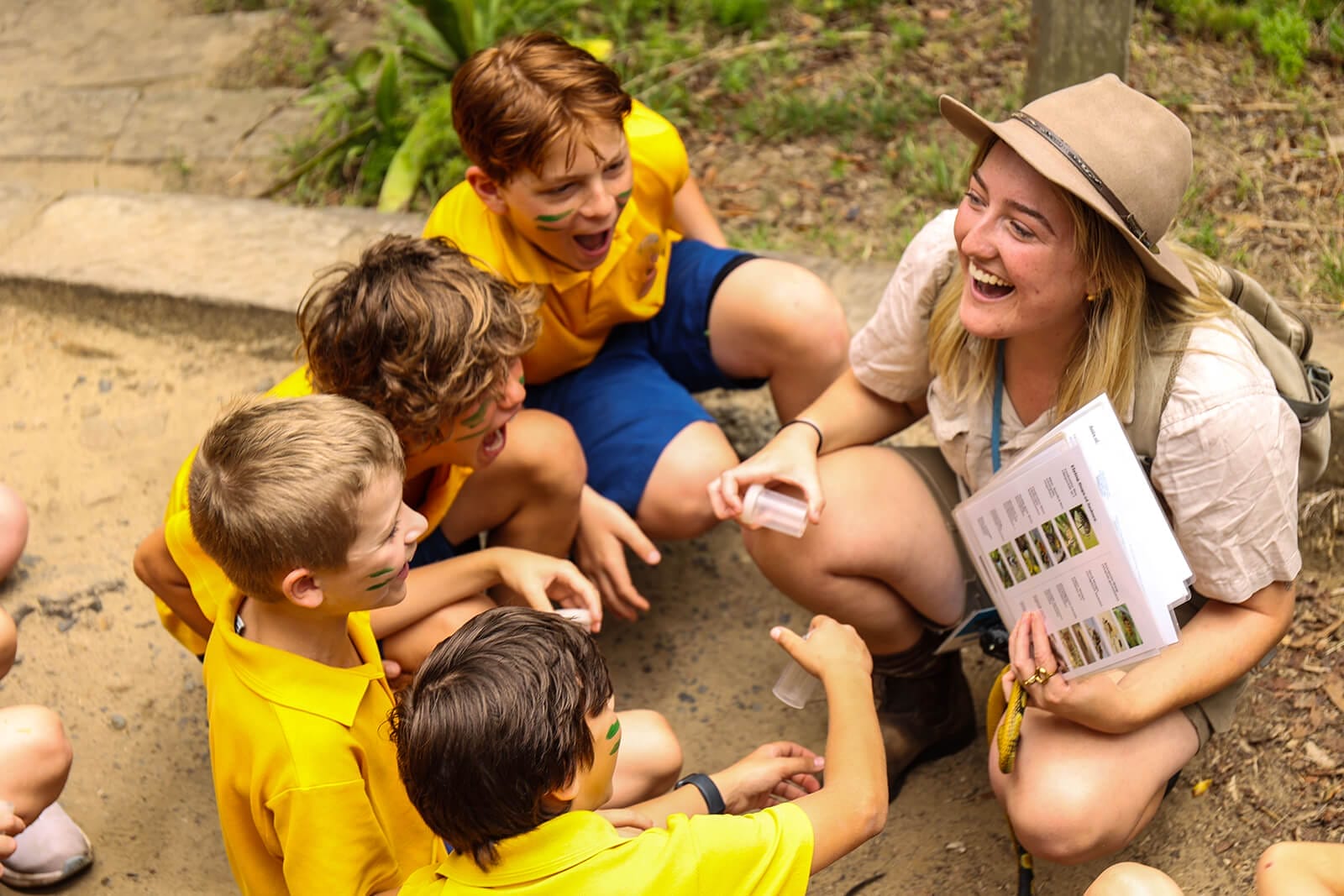
In this hands-on incursion, students investigate how living things survive by exploring the natural systems that support life - air, water, land, and living things. Through interactive activities, they will discover how animals move, identify vertebrates and invertebrates, and explore how plants rely on soil, water, and sunlight to grow.
Students will take part in engaging experiences such as bug hunts, habitat investigations, habitat building, and creating simple food chains to understand how energy flows through ecosystems.
This exciting session encourages curiosity, observation, and environmental awareness, all while bringing the wonders of nature right into the school environment.
Please find our day outline as follows:
9:30 am – 2:30 pm (5 hours)
Our Rangers will happily work around your bell times and scheduled breaks to create a schedule that suits your school day.
Introduction (Approx. 45 mins)
Meet our Rangers and our lineup of exciting taxidermies, the line up is always changing
Activity Rotations
Students split into groups of approx. 35, each led by a Ranger. Groups rotate through all activities in different orders.
Activity 1: Bug Catching
Activity 2: Bird Houses
Activity 3: Habitats
Activity 4: Waterworks
Activity 5: Running Game (If time permits)
Wrap-Up & Goodbye
A final farewell from our Rangers, already excited for your next adventure!
Our Rangers will arrive approximately 45 minutes early to set up.
Please note this schedule is a guide and may vary slightly on the day.
This program links directly to NSW syllabus outcomes. Relevant outcomes are shown below:
ST2-SCI-01 uses information to investigate the solar system and the effects of energy on living, physical and geological systems;
ST2-PQU-01 poses questions to create fair tests that investigate the effects of energy on living things and physical systems;
ST2-DAT-01 uses and interprets data to describe patterns and relationships;
ST2-DDT-01 uses a design process to create products to address user needs or opportunities;
ST2-DDT-02 designs and uses algorithms, represents data and uses digital systems for a purpose.
Living things depend on energy and materials to survive
- Identify the systems of Earth that make up environments: air – atmosphere, land – lithosphere, water – hydrosphere, living things – biosphere;
- Describe how the needs of living things are provided by the atmosphere, hydrosphere and lithosphere;
- Describe the relationship between habitat, ecosystem, and environment;
- Observe and describe living and non-living things in a habitat;
- Pose questions to conduct fair tests to determine the effects of soil, water and light energy on plants;
- Describe how Aboriginal and/or Torres Strait Islander Peoples’ practices support habitats to survive;
- Describe the transfer of energy between plants and animals using food chains, Tier 2 and Tier 3 vocabulary;
- Describe ways in which plants and animals depend on each other for survival.
Body systems work together to enable movement
- Recognise that all animals are either invertebrates with no spine, or vertebrates with a spine;
- Compare ways invertebrates and vertebrates move on land, in water and in the sky;
- Recognise that the human muscular and skeletal systems work together to enable movement;
- Identify parts of the human skeleton that offer protection and support;
- Model how bones, muscles and joints work together to cause movement.
The cost of this exciting adventure is $24.00 + GST per student.
(Minimum charge x35)
This price includes:
- A pre-completed Risk Assessment to make planning easy;
- Full administrative support from our team;
- All materials and equipment provided, you bring the kids, we’ll bring… well, everything else;
- Enthusiastic and knowledgeable Rangers leading the fun;
- A syllabus-aligned program designed to deliver real learning in a hands-on, exciting way.
Choose Your Date
Step 1 of 3
Please note: The Tramway Museum is available for excursions on Wednesdays only. This is a tentative booking. After your booking request is submitted, we will be in touch via email to confirm the requested date and arrange the final details for the booking.
All prices are +GST. As this program is an educational service, all GST charged can be reimbursed in its entirety by the Government.
FAQS
What space or equipment do we need to prepare?
We provide all equipment and materials, so all you need to bring is your students. To ensure everything runs smoothly, we recommend the following spaces:
- Introduction: A large hall space
- Bug Catching: An outdoor area, such as a garden or grassy oval.
- Waterworks: A splash-proof outdoor area, next to a tap.
- Bird Houses: Can be constructed indoors or outdoors
- Habitat Building: an outdoor space with plenty of natural materials nearby.
- Running Game: a large open area such as an undercover COLA or hall space.
Do all Rangers hold a WWCC?
Absolutely. Every Ranger has a valid Working With Children Check and all required training. We can show ID and credentials upon signing in at your school.
If you’d like staff details in advance, just let us know. We finalise our rosters about a week ahead and can provide this information then.
What time will the Rangers arrive?
Our Rangers arrive approximately 45 minutes before your start time so they can sign in, set up, and get everything adventure-ready.