

People Understand and Care for the Environment
Stage 2
HSIE Excursion


Step into a hands-on environmental adventure where curiosity sparks, questions grow, and learning comes alive. Your students will investigate living and non-living things, explore how people use and care for places, and develop a meaningful connection to the environment through active, outdoor discovery.
Led by our enthusiastic guides, students will be laughing, exploring, and learning through memorable experiences such as habitat building and bug catching. Along the way, they’ll begin to understand how their everyday choices can play a role in protecting the environment.
Directly aligned with the Stage 2 Geography syllabus focus People understand and care for the environment, this immersive experience transforms curiosity into care through engaging, purpose-driven learning.
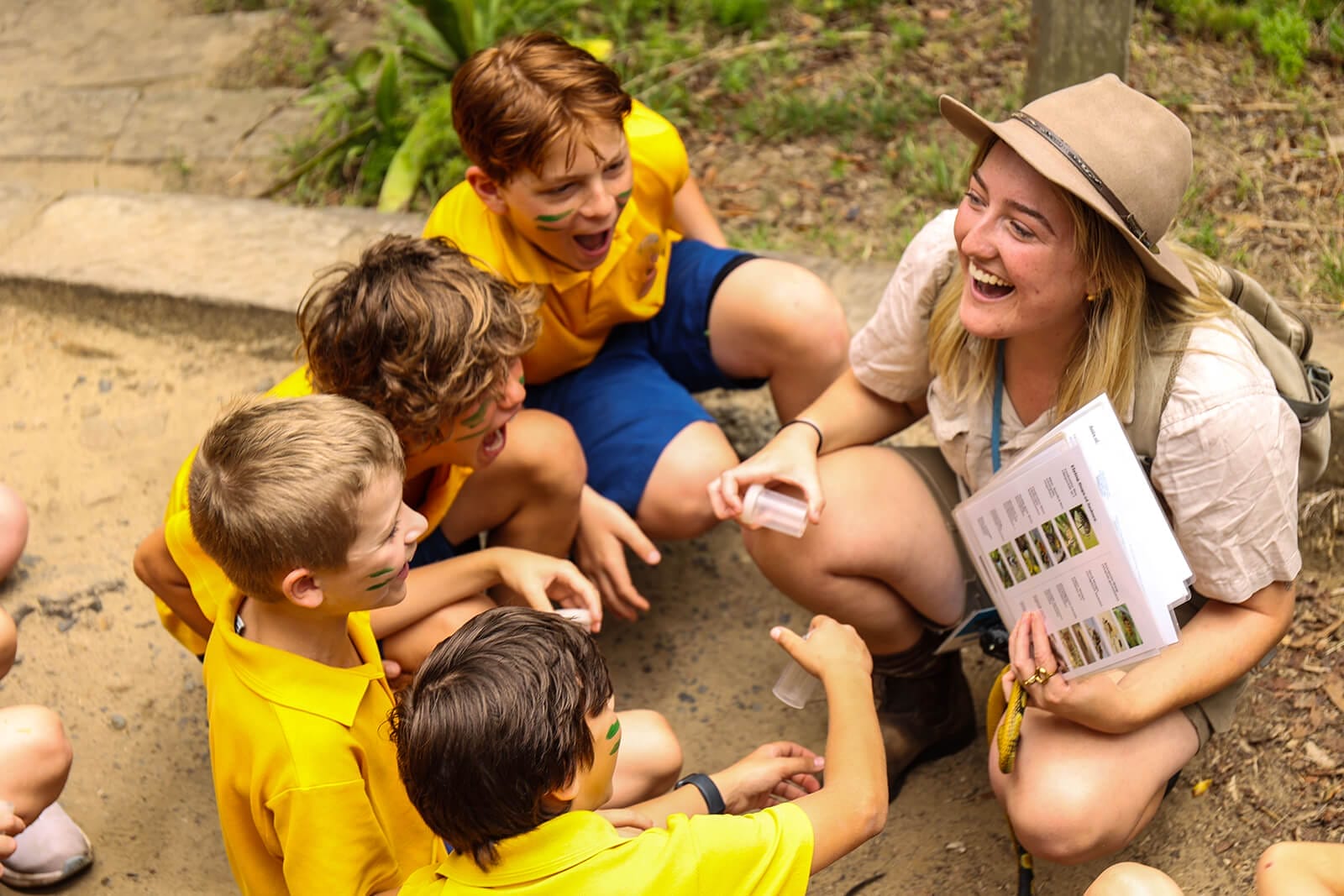
Please find our day outline as follows:
10am- 2pm (4 hour)
Arrival at 10:00am
Our Rangers will be waiting right at the bus bay to greet you upon arrival
10:00am – 10:25am
Arrival, morning tea, and a toilet break.
10:25am – 10:55am
Time for the Ranger Jamie Animal Show! Students get up close to our wild collection of taxidermies, anything from cute possums to giant crocs. The line-up changes daily… because we like to keep things interesting.
After the show, students are split into groups of approximately. 35, each with their own Ranger. Activities run on rotation, so groups may complete experiences at different times.
10:55am – 11:30am
Activity Rotation 1
11:30am – 12:00pm
Activity Rotation 2
12:00pm – 12:30pm
Lunch and toilet break, a well-earned pit stop for hungry explorers (and teachers!).
12:30pm – 1:10pm
Activity Rotation 3
1:10pm – 1:50pm
Activity Rotation 4
1:50pm
Wrap-up and a final toilet stop.
2:00pm
Departure time… and we’ll sadly say goodbye (until your next Ranger Jamie adventure!).
Please note: Times may vary slightly on the day. This schedule is a guide only.
Activities will vary based on the location and the natural features available. These may include:
- Beach/ Bush Habitat Building;
- Dip Net Fishing;
- Hand Reel Fishing;
- Bush/ Coastal Walk;
- Waterworks;
- Crab catching;
- Bug Catching;
- Bird House Crafting.
This program links directly to NSW syllabus outcomes. Relevant outcomes are shown below:
HS2-ACH-01 describes Aboriginal Peoples’ obligations to Country, Culture and Community;
HS2-GEO-01 explains how people care for Australia’s environments and participate in Australian society, using geographical information;
HS2-ACH-01 describes Aboriginal Peoples’ obligations to Country, Culture and Community;
HS2-HIS-01 explains how people lived in the past, how navigation connected the world, and what life was like in the Sydney Cove penal settlement, using sources as evidence.
People use geographical information to understand climates and environments
- Identify polar, continental, temperate, tropical and dry climate zones in the world in relation to the equator and poles;
- Identify and compare climate zones in Australia using choropleth maps showing temperature, humidity and vegetation;
- Compare seasonal rainfall in places in Australia and display data in column graphs;
- Locate and compare deserts, forests, mountain ranges, rivers, ocean trenches and volcanoes of Australia and the world using grid and relief maps and compass directions north, south, east and west;
- Describe ways Aboriginal and Torres Strait Islander Peoples map Country and Place;
- Describe settlement patterns in Australia using satellite images;
- Draw conclusions about how climate influences settlement patterns in Australia;
- Identify and describe significant natural and cultural environments of the world using Tier 2 and Tier 3 vocabulary;
- Compare natural and human features of Australia with another country.
People have responsibility to care for Australia’s environments
- Observe and describe ways people organise places into spaces for different purposes;
- Compare the objectives of managing places for conservation and managing places for sustainability;
- Describe how reserved lands are managed in New South Wales at Mungo National Park, Kosciuszko National Park, Wollemi National Park and Barrington Tops National Park;
- Identify strategies that minimise waste and make the most of resources to sustain environments;
- Investigate Aboriginal and Torres Strait Islander food practices that are sustainable.
North Sydney
- Bobbin Head Ku-ring-gai National Park
- Clifton Gardens Chowder Bay Mosman
- Nielsen Park Vaucluse
- Berry Island Reserve
- Balmoral Beach, Mosman
- Clontarf Reserve, Manly
- Fagan Park
- Putney Park
- Wahroonga Park
Eastern Suburbs
- Cromwell Park South, Malabar
- Queens Park
- Robertson Park, Watsons Bay
- Yarra Bay Bicentennial Park, Botany
Inner West
- Ballast Point Park, Birchgrove
- Cabarita Park
- Elkington Park, Balmain
- Glebe Foreshore Parks
- Rodd Park
- Rozelle Parklands
- Sydney Park, Alexandria
South Sydney
- Audley to Bola Creek Rainforest Royal National Park
- Bonnie Vale Royal National Park
- Carss Park Bush Flat
- Garie Beach to Bola Creek Rainforest Royal National Park
- Gunnamatta Park Cronulla
- Wattamolla Royal National Park
- Bonna Point Reserve, Kurnell
- Garie Beach
- Bundeena
- Cooper St Park, Engadine
- Cook Reserve, Ruse
- Pine Park, Sans Souci
Western Sydney
- Auburn Botanic Gardens
- Mcarthur Park
- Lizard Log, Western Sydney Parklands
- Nurragingy Reserve, Doonside
- Plough and Harrow, Western Sydney Parklands
- The Dairy, Western Sydney Parklands
Illawarra
- Stanwell Park Beach Reserve
- Bald Hill to Stanwell Park Beach Reserve
- Blackbutt Reserve, Shellharbour
- Killalea State Park, Shellharbour
- Shellharbour South Beach
- Stuart Park, Wollongong
Newcastle, Central coast & Hunter valley
- Blakbutt Reserve, Kotara
- Brickworks Park
- Hunter Valley Gardens
- Foreshore Park
- Kincumba Mountain Reserve
- Norah Head Lighthouse
- Poppet Head Park
- Richley Reserve
- Swadling Reserve
- Lions Park, Woy Woy
- Speers Point Park
- Tanilba Bay
The cost of this exciting adventure is $24.00 + GST per student.
(Minimum charge x35)
This price includes:
- A pre-completed Risk Assessment to make planning easy;
- Full administrative support from our team;
- All materials and equipment provided, you bring the kids, we’ll bring… well, everything else;
- Enthusiastic and knowledgeable Rangers leading the fun;
- A syllabus-aligned program designed to deliver real learning in a hands-on, exciting way.
Choose Your Date
Step 1 of 3
Please note: The Tramway Museum is available for excursions on Wednesdays only. This is a tentative booking. After your booking request is submitted, we will be in touch via email to confirm the requested date and arrange the final details for the booking.
All prices are +GST. As this program is an educational service, all GST charged can be reimbursed in its entirety by the Government.
FAQS
How many teachers/helpers do I need on my excursion?
The more grown-up sidekicks, the better! We recommend at least one teacher/parent helper per class. No extra cost for teachers or parent helpers on this program.
What equipment/ materials do we need to bring?
Students should bring morning tea, lunch, water bottles, and any required medication. We suggest sports uniforms and comfortable shoes. We supply all the materials and equipment needed for your day.
What is the weather policy?
You can view our full policy here
We’re flexible and happy to arrange an incursion alternative or, where needed, postpone your program.
How many groups will my students be in?
We usually plan for one Ranger per 35-40 students. On the day, your students will be split into groups of that size, with a Ranger assigned to each group to guide them as they rotate through the activities.